
Hachioji Castle: a whole mountain of a castle, an hour from Shibuya

- Castle
- Hachioji Castle (八王子城)
- Built by
- Hojo Ujiteru
- Location
- Hachioji, Tokyo
- Type
- Mountain castle (yamajiro)
- Designation
- National Historic Site
- Japan's Top 100 Castles
- No. 22
Most of Japan’s Top 100 Castles come with a keep, a car park and a ticket booth. Hachioji Castle has none of those. The buildings are long gone. What’s left is the mountain itself — terraces, stone walls, gates and ditches cut into the slopes — and that turns out to be the better thing to see. You don’t look at this castle. You walk it.
Start at the guidance centre
The small guidance centre at the foot of the site is free, and it’s where the Top 100 Castles stamp lives. Spend time here before you climb — it makes the mountain make sense.
The castle was the mountain stronghold of Hojo Ujiteru, third son of Hojo Ujiyasu, whose family ruled the Kanto from Odawara. Work on it seems to have started around 1582. It was the largest of the Hojo’s branch castles and is seen as the high point of their castle building. It lasted barely a decade. In the summer of 1590, during Toyotomi Hideyoshi’s campaign against the Hojo, it was stormed and fell in a single day — most of its defenders were away at Odawara, and the armies of Maeda Toshiie and Uesugi Kagekatsu came at it from more than one side. The displays walk you through which way each force came in and how the castle gave way.
That’s the part worth knowing, because afterwards you can go and stand on those same approaches. The displays have English explanations of the history too, so if you want the full story in more detail than we can give here, this is the place for it. Outside, near the management building, there’s also a large relief model of the mountain that shows where everything is.
The castle itself
The castle had four parts: the Honmaru on the summit, the fortified mountain around it, the lord’s residence at the foot, and an outer ring of defences. Archaeologists have been digging here on and off since 1977, and most of what has been restored is at the foot.
From the centre, the reconstructed Hikihashi bridge (the wooden bridge in the photo) crosses the stream to the Goshuden, the lord’s residence. You climb to it up a stone-paved approach about 5 m wide, through a stepped gate, onto a terrace of more than 6,000 m². Excavations here found the remains of many buildings, a pond garden and more than 70,000 objects, and the site was laid out again to show where the halls stood. It’s the most restored part of the castle, and the easiest to picture in use. Look behind the terrace, though: the stone walls there have been left as they were found, and they’re the original work.
Above it the mountain climbs to the Honmaru, the main enclosure at the summit, about 460 m up. It’s a proper hike, about 30 minutes from the management building on a steady path through cedar, passing old terraces and smaller enclosures such as Matsuki-kuruwa and Komiya-kuruwa on the way. Not far from the management building is the grave of Hojo Ujiteru and his retainers.
The ditches of Taiko-kuruwa
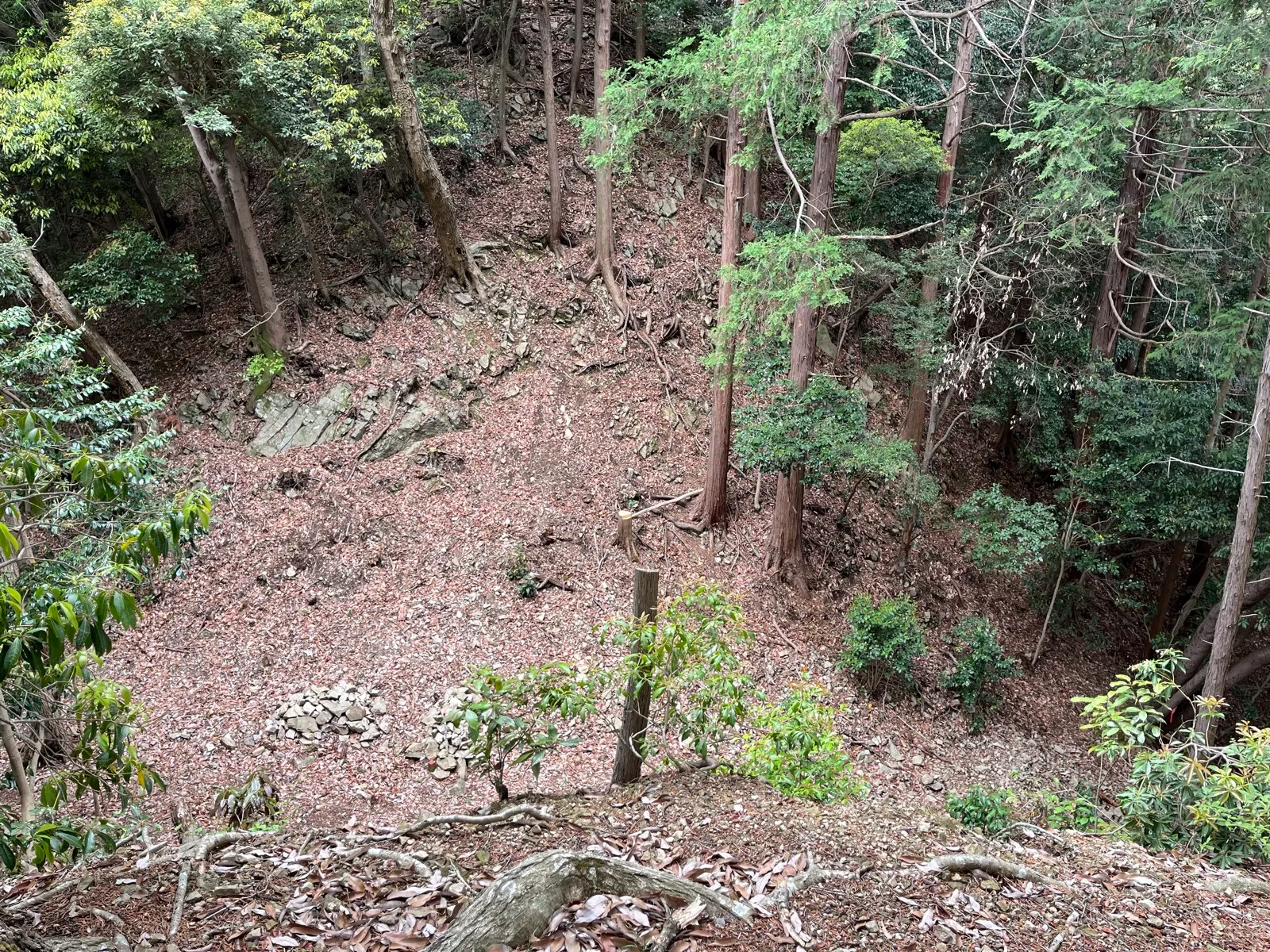
The photo looks down from the Taiko-kuruwa enclosure (410 m) onto the ditches cut into the ridge below.
These are horikiri: trenches dug straight across a ridge to stop an enemy from simply marching up it. Each one is four or five metres deep, and there isn’t just one. They run one after another down the ridge, and they show how strongly Hachioji Castle was built.
In 1590, during Toyotomi Hideyoshi’s campaign against Odawara, the armies of Maeda Toshiie and Uesugi Kagekatsu attacked the castle. Its lord, Hojo Ujiteru, and most of his soldiers were away defending Odawara Castle, so only a small garrison was left. The castle fell in a single day. Even so, the attackers are said to have lost many men.
Climb down into one of the ditches and look back up, and you can see why. Anyone trying to cross here would have been shot at by archers from above. It’s something you only really feel standing on the spot, and it’s worth the walk.
West along the ridge: the ditches
Keep going west past the summit and the castle becomes a ridge walk. This side faced the attack from the mountains behind, and it was defended by horikiri — deep cuts through the ridge itself. You walk along a narrow crest, and then the ground simply stops: a man-made trench, sliced straight across, that you climb down into and out of. The biggest, the Ohorikiri, makes it obvious how much earth people moved by hand to hold this line.
Beyond the castle
The ridge doesn’t end at the castle. It carries on as the Kita-Takao range, linking round to Mt Takao and on towards Mt Jinba — a long day of up and down on quiet trails, and one of the pleasures of walking the hills west of Tokyo. Go as far as you like and drop down to a bus stop; bring water, cash and a map, and check the last bus.
Opening hours and facilities
- Castle site: open all the time, free to enter.
- Guidance centre: 9:00–17:00, free. Closed 29 December – 3 January and on occasional other days.
- Top 100 Castles stamp: inside the guidance centre, so only during its opening hours. There’s no stamp at the management building by the car park.
- Toilets: at the guidance centre, available 9:00–17:00. There are none further up the mountain.
- Car park: free, about 50 spaces, 8:30–17:00.
- Food and water: there are no shops on the site. Buy what you need at Takao station before you get on the bus.
If you go
- Start early; the guidance centre and the Goshuden alone take an hour or two.
- Weekends are easier for the bus. On weekdays, allow for the walk from Reien-mae.
- Boots rather than trainers for anything beyond the Goshuden.
If you’re staying at Okushibu Residence, this is an easy day out from the door. And if you don’t want to fly in with boots and a pack, we keep them for you.
Getting there
From Okushibu Residence to Hachioji Castle
About 1 h 25 min door to door
- Okushibu Residence
- Walkabout 15 min
- Shibuya station
- JR Chuo line or Keio lineabout 60 min
- Takao station
- Nishi Tokyo bus 城01 (weekends)about 10 min
- Hachioji Castle
- Weekdays
- Take any bus from stop 1 at Takao station (north exit) to Reien-mae / Hachioji-joato Iriguchi (霊園前・八王子城跡入口), then walk 15–20 minutes up the lane.